
Blog - The Film "Naza"
A moderated series of blogs on the Film Naza
The vicious attack of October 7th 2023 by Hamas on Israel, the subsequent violence and humanitarian consequences have caught the attention of millions around the world. The Israeli-Palestinian conflict has been, for many decades, one of the most intractable conflicts of our time This intractability has led to a sharp polarisation of views and the room for a reasoned, fact-based dialogue has become increasingly constrained.
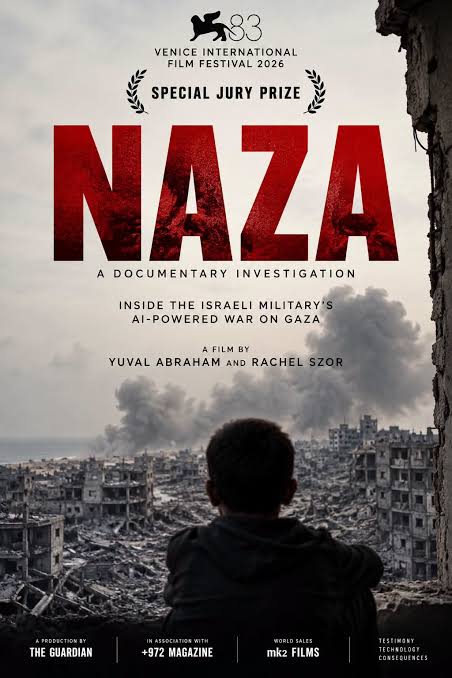
The film ‘Naza’ is a British documentary, produced in 2026, was written and directed by Yuval Abraham and Rachel Szor. It drew considerable attention at the film festivals in Venice and Cannes.
This page on EuroISME’s website will be devoted to a series of articles concerning the film, which itself has become the object of a heated debate. The series of articles will be moderated by EuroISME’s Managing Board. Contributions from EuroISME’s audience are welcomed; contributions which are insulting, discriminatory or hateful will be declined.
Although the published articles are moderated, the represent the views of the authors only; they do not represent an official point of view.
Please send manuscripts to <
You can download our guidelines for blog contributions here: Download our Guidelines for Blog Contributions (PDF)
Since its inception in 2011, EuroISME has been a European forum for discussion and the exchange of ideas on professional responsibility and military ethics. In these particularly trying times, a forum is need for a thoughtful analyses on the current crises which are pertinent to military ethics. The current blog series aims to make space for this need.
The film Naza and the loss of a fruitful dialogue
- Details
- Blog: Blog - The Film Naza
The film Naza and the loss of a fruitful dialogue
By: Ted van Baarda (1)
Early October I had the opportunity to view the film Naza in the cinema of the town where I live. Of course, I had seen in the newspapers the acclaim the film makers had received at the festival in Cannes as well as the angry reaction by the Israeli government.
My curiosity was sparked further by the fact that a few days prior to my visit, during the première, a protester stood up when the film had already been running for about 10 minutes. According to news reports, the main protester was a lady who had survived the cruel attacks of October 7 while her family members had not. An aide of the lady simultaneously held up a white cloth on one of the side walls of the hall, while a third person beamed images of Hamas’ terrorist attack onto the cloth. When the audience started to shout, yet another aide started to record the reaction of the audience. There was a short struggle about the recording device and eventually the lights went on.(2)
The incident is not what I expect in my usually quiet town. The Dutch quality newspaper NRC Handelsblad (3) did therefore some research. It revealed that the lady concerned had visited the right-wing parliamentarian Geert Wilders before the incident; the newspaper published a photograph of them proudly standing together. It also revealed that the lady had links with Israeli veterans who are active to suppress, what they call, ‘anti-Israeli propaganda’. Upon return in Tel Aviv the lady was, within a few hours, received by prime minister Netanyahu. The NRC Handelsblad consulted a number of experts and concluded that this was not the first time that an incident occurred that came precariously close to foreign interference in the domestic affairs of my country.
My impression is that the strength of the film is also its weakness. The film offers the testimonies of two dozen anonymous Israeli soldiers who use AI-enabled systems, including Lavender, to target Hamas operatives in the Gaza strip. Although red flags had already been raised in many sections of the international community about the level of violence applied by the IDF, this is one of the first accounts coming from inside Israel itself. The testimonies given are those of the perpetrators.
The detail is gruesome. Because the IDF can tap all telephones in Gaza they know exactly which Palestinian is where and what is going on. The signal of the telephone is a key element of their intel. So, if they hear a 12 year old girl ask her mother whether daddy is home, they hear the answer yes. Then they know that they can drop the bomb, regardless of the lives of the girl and the mother. However, if a Hamas operative forgets his telephone when leaving home, the bomb homes in on the signal of the telephone, killing the members of his family but not the operative. Such testimonies in a closely knit society as Israel’s are very risky to say the least. The film makers may see their passports revoked by their government – which is not exactly what I would expect from a democracy where peaceful dissenting opinion should be allowed.
A key weakness of the film is that it offers no conceptual framework. Although the word naza is apparently Hebrew for collateral damage, the film does not explain the concept of collateral damage. In the Geneva Conventions if official terminology is “incidental loss of civilian life, injury to civilians and damage to civilian objects.” The commonly used short hand is ‘collateral damage’ which is, according Article 51(5) of Additional Protocol I (1977), is deemed permissible, so long as all feasible precautions are taken and the harm is not “excessive in relation to the concrete and direct military advantage anticipate”. This is also to be found in customary law. Thus, the film makers should have made clear that under international humanitarian law not all collateral damage is unlawful; unlawful is only the collateral damage that does not pass the triple test of proportionality, distinction and precautionary measures.
The lack of a conceptual framework becomes problematic when cases are discussed. The film repeatedly mentions the presence of a Hamas operative in a civilian building -- i.e. when he sleeps with his family – but the film takes no trouble in discussing the required balancing act between military necessity and collateral damage. A viewer who is well-versed with the concept of war crimes can fill in the aspects which are not mentioned, but the member of the audience who is less well versed such omissions is likely to be placed on the wrong foot.
The lack of a conceptual framework has also bedevilled the makers: the film mentions sharpshooters who shoot civilians who are so hungry that they jump the queue and run at a food distribution centre. However, these civilians are not collateral damage; these are cases of the deliberate targeting of civilians. That is a war crime by any standard.
Yet, the fact that the film makers were able to collect 24 accounts is far more important than the legal inaccuracies. Such accounts may make it possible to break down the culture of denial which still exists. Thus, the film may contribute, hopefully, to a culture of accountability both in a moral and in a legal sense.
Of course, I realise that attempts in Gaza to minimise collateral damage frequently have gone nowhere as a result of the IDF’s callousness. As I have argued in a previous blog, the application of violence by the IDF is disproportionate(4) even though the concept of proportionality is open to disparate interpretations informed by utilitarianism or deontology.(5) To compound matters, international humanitarian law makes no distinction between – what I would call – ‘honest’ collateral damage, whereby the commanding officer does his best to avoid civilian casualties when hitting a target, and callous collateral damage, whereby the commanding officer doesn’t care how many civilians are hit in the targeting process. The film presents that callousness without holding back. Although I am no position to check every detail presented in the film, I have no reason to question the veracity of the interviews in general. Yet, because of the lack of a conceptual framework and an articulate discussion of the dilemmas involved, the film lacks in my view balance.
Nonetheless, there is great value in the film coming out. I agree with a press discussion in Holland which relates Naza to the conceptual framework Hanna Arendt offers in her book Eichmann in Jerusalem.(6) She coined the concept of the ‘banality of evil’. This banality is portrayed in the film in a compelling way. One of the soldiers is heard saying that he knows the Germans were bad, but, then, what is the IDF? Life in Tel Aviv goes on, largely as normal, while at an hour’s drive distance a bloodbath is taking place. The banality could not have been shown with starker footage. Another soldier was asked whether he discussed his feelings with the colleagues from his unit and the immediate answer was no – he was tasked to focus on the technical aspects only. The choice of words in the film is remarkably clinical. The interviewees speak in the context of a given sortie of 20 naza, or 30 naza or even 500 naza. Language thus obscures the fact that twenty, thirty or five hundred humans have been killed – babies, children, innocents regardless. In that press discussion it was commented such mass murder is not a typically German thing, nor a typically Israeli thing, but frighteningly, universally human. How much is needed before another society falls over the precipice and engages in comparable actions?
To me, the film also brought back memories of a publication which I read decades ago about the Truth and Reconciliation Commission chaired by Desmond Tutu.(7) At that time, the question of remorse was raised, next to the question of psychological trauma. Naza does so in passing. Between the lines, when I hear a difficult silence or a choking voice, I gather that remorse and trauma could be the topic for another documentary. Goboda-Madikizela, a member of Tutu’s commission and a psychologist, described the difficulties she experienced in conducting in-depth interviews with a perpetrator. The topic was simply too sensitive. That the film makers of Naza have done it, is a testimony to their perseverance. According the one of the film makers, it took them three years to make the film, in cooperation with +972 Magazine and the Guardian.(8)
In short, Naza needs an audience which is well-versed in humanitarian law, military ethics and perhaps also military psychology in order to be consumed with the necessary nuance. But for the public at large, or for those closely involved, that need for nuance is asking too much. Vehement emotions will be swayed accordingly. The heated demonstration of the lady in the cinema in my town in combination coupled with the reactions of the audience illustrate this. No space is left to listen to the pain of the other – even though that pain on both sides is very real. Precisely the empathy that is necessary has evaporated. Criticism of one side in the conflict seems to imply, in the public eye at least, that one is supporting the other party of that conflict or vice versa. In this cacophony of opinions, everyone seems to listen only to sources that one finds appealing. The public debate thus becomes a hopeless zero-sum game, whereby the participants of that debate call each other thugs, terrorists and the like, but will not find a conclusion. The loss of a balanced, nuanced dialogue is but another victim of the spiral of violence.
Notes:
(1) The author is Executive Director of EuroISME. He writes this blog in his personal capacity. The opinions expressed in this blog do not necessarily represent those of EuroISME’s Board of Directors.
(2)OmroepWest,https://www.omroepdelft.nl/delft/binnenstad/vrouw-verstoort-vertoning-documentaire-over-gaza-in-filmhuis-lumen/;NU,https://www.nu.nl/media/6411742/israelische-vrouw-onderbreekt-vertoning-documentaire-naza-in-delft.html
(3) NRC Handelsblad, 10 October 2026, “NCTV waarschuwde al voor Israëlische inmenging: gebeurde dat ook in Delft?” p. 8-9.
(4) Ted van Baarda, Assessing the proportionality of the violence in the Gaza strip, <https://euroisme.eu/index.php/en/blogs/views-on-the-crisis-in-the-middle-east/396-assessing-the-proportionality-of-the-violence-in-the-gaza-strip>
(5) Ted van Baarda, “Quo vadis? Concepts of moral and legal philosophy underpinning the laws of armed conflict,” The Philosophy of International Law, (2014) vol. 5 issue 2, p. 33 et seq.
(6) Bram Vermeulen, Pauw en de Wit, <https://npo.nl/luister/podcasts/1393-de-wit-and-de-wereld/146539; https://www.youtube.com/shorts/guG1g04WVhk>
(7) Pumla Goboda-Madikizela, A human being died that night – South African story of forgiveness, New York, 2003.
(8) Yuval Abraham, interview with MS Now, 11 Oct. 2026, <https://www.youtube.com/watch?v=Z_Q7eq7yrt8>